
African Swine Fever (ASF) continues to challenge the pig sector across Europe. Beyond the immediate animal health consequences, outbreaks disrupt international trade, threaten farmers’ livelihoods and test the resilience of entire production systems. While no single solution exists today, one message is becoming increasingly clear: controlling ASF requires experience from the field, strong biosecurity, scientific innovation and international collaboration.
These were the key conclusions emerging from the recent VAX4ASF webinar, which brought together experts from Spain, Italy and the VAX4ASF consortium to discuss how Europe is responding to one of the most complex animal diseases of our time. Rather than focusing solely on the disease itself, the discussion explored the lessons learned from recent outbreaks and the innovative research that could shape future control strategies.
Learning from Spain: protecting farms while maintaining confidence
Representing ANPROGAPOR, Arturo Hernangómez offered a comprehensive overview of Spain’s experience following the detection of ASF in wild boar in late 2025. His presentation highlighted not only the epidemiological evolution of the outbreak but also its profound economic consequences for one of Europe’s largest pig-producing countries.
One of the strongest messages from his intervention was that timing matters. The outbreak occurred at a particularly difficult moment for the Spanish pig sector, when production had recovered, storage facilities were full, and international markets were essential for maintaining profitability.
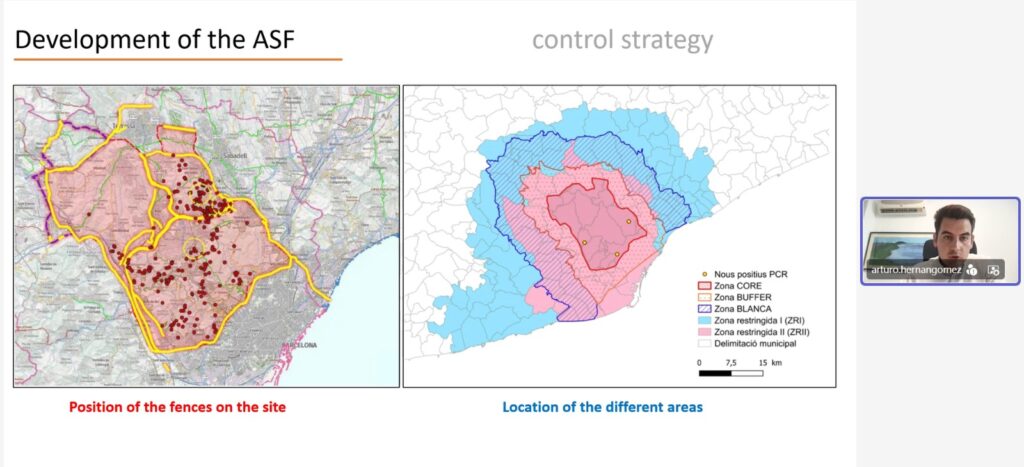
Despite these challenges, Hernangómez highlighted the coordinated efforts undertaken by veterinary authorities, producers and industry organisations to contain the disease. Extensive surveillance, fencing, targeted wild boar population management and strict regionalisation measures have allowed Spain to keep approximately 91% of its export markets open while preventing the virus from reaching domestic pig farms. However, he stressed that preventing infection at farm level remains the absolute priority.
For farmers, he explained, the most effective tool currently available is rigorous biosecurity. Every preventive measure implemented on farms reduces the risk of the virus entering domestic production, where the consequences would be significantly more severe.
At the same time, Hernangómez pointed towards the future, expressing hope that new vaccine technologies under development through initiatives such as VAX4ASF will eventually become an additional tool in Europe’s disease control strategy.
Biosecurity begins with people
If there was one message that resonated throughout the webinar, it came from Umberto Rolla, veterinarian and production manager at Martini in Italy. Reflecting on Italy’s experience since ASF first entered the country, Rolla challenged one of the most common assumptions surrounding disease transmission.
“ASF travels on wheels, not on wild boars.”
Rather than placing responsibility solely on wildlife, Rolla explained that human activity frequently plays a decisive role in spreading the virus. Vehicles, equipment, boots and movements between farms can all become pathways for infection if strict biosecurity protocols are not consistently applied.

His intervention also introduced an important distinction between infrastructure and behaviour: “The problem is not the hardware,” he explained. “The problem is the software.”
Having fences, Danish entry systems or changing rooms is only part of the solution. Their effectiveness depends entirely on people’s daily commitment to following biosecurity procedures without exception.
Another critical lesson from Italy concerned early detection. Delays in reporting suspicious cases can rapidly transform isolated infections into much larger outbreaks. Transparency, rapid diagnosis and immediate communication are therefore essential components of effective disease management. Rolla also highlighted the growing importance of specialised tools such as trained detection dogs, which have become highly effective in locating infected wild boar carcasses and reducing environmental virus circulation.
Building tomorrow’s solutions through research
While field experience offers valuable lessons for controlling today’s outbreaks, scientific research is working to provide new solutions for tomorrow.
Presenting the latest progress of the VAX4ASF project, Emili Barba, Global Project Manager at HIPRA, explained how the consortium is advancing towards the development of innovative vaccine technologies against African swine fever virus.
The project, now entering its third year, has already achieved significant scientific progress. Researchers have improved their understanding of how the virus interacts with the host immune system, evaluated the first vaccine prototypes in experimental models and continued developing complementary diagnostic tools and epidemiological models.
Barba emphasised that VAX4ASF is not simply seeking to develop any vaccine. The project’s objective is to produce vaccine candidates that combine effectiveness with the highest possible safety standards while supporting DIVA strategies that distinguish vaccinated from infected animals.
Equally important, the project is working alongside veterinary authorities, producers, hunters and researchers to ensure that future vaccination strategies can be realistically implemented under European conditions. Although it is still too early to predict when a commercial vaccine may become available, the progress achieved so far demonstrates the value of sustained European investment in collaborative research.
Collaboration as Europe’s strongest defence
Throughout the webinar, moderator Isaac Ballarà successfully connected the practical experiences shared by the speakers with the broader objectives of the VAX4ASF project.
Rather than simply introducing each session, he guided the discussion by exploring how field experience, scientific research and international cooperation complement one another in tackling ASF. His concluding remarks captured the central message emerging from the entire event. African Swine Fever is not solely an animal health challenge. It is also an economic, environmental and societal challenge that requires transparency, preparedness and collaboration across borders. No single organisation, country or stakeholder can overcome ASF alone. By bringing together researchers, producers, veterinarians, industry representatives and policymakers, VAX4ASF demonstrates how European collaboration is helping transform today’s lessons into tomorrow’s solutions. While biosecurity remains the first line of defence today, innovation continues to build the tools that may fundamentally change ASF prevention and control in the future.